

Howl Now
Allen Ginsberg challenges us to go the distance: the Emergency Horse Interview part 1, by John Feins

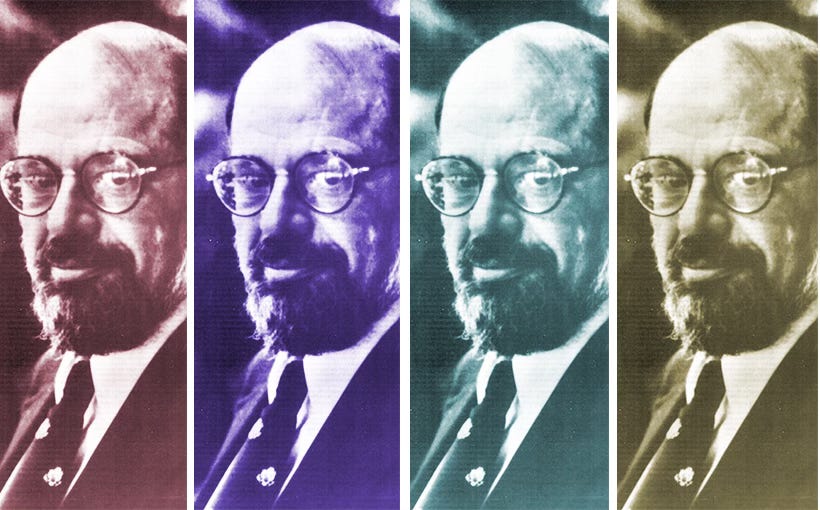
Photo by George Holmes
Santa Fe writer John Feins spent three days with Allen Ginsberg at the Naropa Institute in Boulder, Colorado.
John Feins
I came across a quote of Gregory Corso‘s the other day that was quite provocative.... He said, “The poet, more than any other figure in human time, is the only being unstained by dark, monstrous, unforgivable deeds, and yet, he lives as though he were exiled from life by life; it is a lovely, laborious, unrewarding place—that necessary outskirt. No, the poet is not the happiest of people, indeed, he could well be the least happy.”
Allen Ginsberg
I’ve heard Gregory say a parallel thing about the Beat Generation. That it’s the only bloodless revolution, that the poets created a revolution that didn’t draw blood, that was not intended to draw blood, and didn’t have as consequence blood, death, or violence....
Though there are a few poets like Marinetti, the Futurist, who backed Mussolini, and in that sense was praising war and blood—it’s just language. Though on the other hand, Williams says, “The government is of language” [laughs], do you know that phrase? Say Ronnie Reagan or George Bush gets up and reads speeches written by their speech writers ... it’s language. Just like the poets write poetry, they write their texts. We write our texts, it’s all texts or it’s all theater or it’s all poetry. It’s all language, anyway. The laws are made out of language. The Congress is language. The president gives speeches. So it’s all bullshit, so to speak, one way or another, whether it’s poetry or politics it’s all the same la-di-da language, babble. So from that point of view, Eliot said, “Our concern was speech and speech impelled us to purify the dialect of the tribe, and urged the mind to aftersight and foresight.” And Williams said, “The government is of language.” And I think Pound quotes Flaubert on the job of artist or writer to purify the dialect of the tribe, or maybe Eliot is quoting Flaubert, or Joyce said it, but that was the view of the Modernist writers around World War I and the turn of the century. Related to that, I was very conscious of a phrase I’d seen quoted from Plato from The Republic, “When the mode of the music changes, the walls of the city shake.” But he was forbidding poets to change the mode of the music! That was what it meant, if they use the wrong kind of music, it de—bases, it vulgarizes the minds of the citizens. And so he was saying that you shouldn’t be changing the mode of the music, we have the right modes here.
Q
I’ve always used that quote as reason for being...
A
Just the opposite! Yeah. Yeah. But in its context it means the opposite of the way I was using it, but the point is the same.... When the mode of the music changes, when you change the mode or the scales or the rhythm or the structure of the poetry or the music, it affects peoples’ minds. It also affects peoples’ breathing, breathing then affects peoples’ whole physiology (or as Olson said, “Poetry is an extension of physiology”) and affecting peoples’ physiology affects body attitudes, mental attitudes, reactions to each other. It actually affects social relations as Whitman, for example, has affected social relations in the Kinsey Report on the sexual activity of the human male ... a bunch of words which gave instances and statistics. Or as Uncle Tom’s Cabin or Frederick Douglass’ slave narrative.
Rimbaud had the idea: “The Alchemy of the Word” ... that there may be some combination of sounds, correspondences with language or images or sounds or the vowels which actually have a physiological effect on the body and change peoples’ consciousness.
There’s the traditional thing of Mantra and seed syllable being used to change the body and the mind, to protect the mind.... Mantra, mind protection, man- mens- mind, tra-protection. Or Antonin Artaud thought that certain vibrations of the voice would enter the nervous system and change the molecular structure of it, and so therefore change the physiological of the mind and the consciousness. And at my reading, with Graphic Winces, I was trying to see if there was a series of images that actually have a physiological effect on the body and make a sharp tingling in the perineum. So, in other words, language does have an effect.
On the other hand, there’s the other view, which I’ve always held simultaneously, that you can do and say anything you want in the imagination and poem. The poem is a field where you can murder, create, destroy the universe, create it, kill your mother-in-law, eat your own cock—it’s harmless, it’s only words. So it’s both…So then there’s always this big argument about responsibility [laughs] .... But what is he [Corso] saying about in relation to society?
Q
Even though he’s unstained by these “dark, monstrous deeds,” he “lives as though he were exiled from life by life; it is a lovely, laborious, unrewarding place—that necessary outskirt.”
A
Well, any man of sensitivity is exiled from life by life. Every Buddhist is, so to speak. It’s a very beautiful statement actually, and a good way of saying it, a certain psychological attitude and condition, but it refers perhaps to Gregory’s being strung-out, also.
Q
I often worry that poets accept that fate, and almost seek it out sometime.
A
I don’t think so.... Let me point out for the Beat Generation that the major poets were as follows: Kerouac, Corso, myself, Orlovsky, Snyder, Whalen, Lamantia, McClure, Creeley, Burroughs, Lew Welch, Diane DiPrimi—well lots of others that could be called major Beat writers, or associated. Of them, Kerouac drank himself to death and Lew Welch also suffered alcohol—the common American variety of alcoholism. Neal Cassady, we should include, died of amphetamine. Otherwise, everybody’s not only surviving, but flourishing. In the case of Snyder and Whalen, they’ve actually grown from being Zen students to Zen masters, which is remarkable! Burroughs, myself, Snyder, and Creeley are members of The American Academy of Arts and Letters and all are producing.
Q
Founded a school ...
A
With them also I helped found the Naropa Institute joining eastern and western minds and also did something historically interesting. But I’m just talking about survival, survival not accomplishment. So what are we? We probably have a better survival rate than the Academic poets, which is good if you consider Delmore Schwartz, Berryman and others ... and we’re probably statistically as good or better survivors than stockbrokers or insurance men. In terms of alcoholism, early death, tragedy, in some respects maybe the poets are less tragic than most, because they have something pleasant in their lives to deal with and some triumph over adversity and samsara and mental activity that may sustain them till death, even unto the death bed, whereas most people don’t have anything to do on their death bed, a poet can always dictate his last haiku [laughs].
So there’s some sustaining thing going on there. So I don’t think that you can say inevitably poets have a worse fate than anybody else, although good poets do have one problem that other people don’t have, which is that since they are “antennae of the race” or to the extent that they are the unacknowledged legislators, or to the extent that they look in their hearts and write and therefore speak for the unspoken, for the people who can’t speak, to the extent that they speak for the oppressed, or the bewildered, or the confused, or the sufferers, their pronouncements or insights may run counter to the current of the societies in which they live; and that may bring on them the wrath of the society, particularly say in Russia, where among the greatest poets, Mandelshtam, Mayakovsky, Yesenin, in this century, and others, many did not survive the retribution given them for poetry. Like Mandelshtam among the greatest of the twentieth century Russian poets, ultimately sent to Siberia to Kolyma work camp in northeastern Siberia, a vast concentration camp where millions died, for a poem on Stalin, talking about Stalin’s “cockroach whiskers” [laughs] and his bad manners! And apparently got to Stalin, and Stalin got mad. But you know, many people didn’t survive. Or like Socrates, but then again you have Christ who didn’t survive either, from his prophecies. Buddha survived—got to be eighty-two or something. So it may be that in having insights into the mind and into consciousness and in forerunning changes of consciousness within society there is greater risk, perhaps greater risk than for politicians or others and maybe a greater risk of madness or disorientation because it’s like being a one eyed man in the land of the blind; Burroughs’ idea, I think taken from some short story by H.G. Wells or someone. So therefore there may be more stress there, but on the other hand that may toughen up the nature of the poet and maybe even make him stronger and more reliant like Thoreau or something, than the average citizen who just goes along with the conditioned mentality. So I think it’s a myth cultivated by anti-poets [laughs] that poetry has not got a great survival rate. And then there’s also the thing that whether the poet survives or doesn’t ‘Survive, the ones with great tragedies have written their tragedies out in immortal poetry! So that everybody knows about their story whereas they don’t know about the insurance man or the stock-broker’s story or the schoolteacher’s story, because it’s not memorable, but Rimbaud’s story everybody knows, Keats’s story everybody knows, Shelley’s story everybody knows, Hart Crane’s story everybody knows, Kerouac’s story everybody knows, Neal Cassady’s story everybody knows immemorially ... because they were conscious and so specific and so communicative. And poets are the only group that can claim immortality [laughs] rather than shorter life span, such as immortality is, whatever that means. It’s sort of a funny joke when you think about it.
Q
The damage of the Reagan years seem pretty severe.
A
Immense. It’s deeper than I’ve begun to realize.
It’s the cuts in education that are stupefying the populace. There is the polarization of wealth, so that there are more poor people than before, and a few more rich. The polarization of the races and polarization of the comfort and richness of the races. I’ve been doing a lot of reading on black literature, as I said, lately, and am very much impressed by how much Frederick Douglass’ narrative account of his escape from slavery, and the conditions of the slave are kind of models for what’s going on now in the enslavement of blacks into poverty which seems more and more as W.E.B. Dubois analyzed it, a great problem of the twentieth century both nationally and internationally, and at the end of his life in his new preface to the 1963 edition of The Souls of the Black Folk, he altered his initial view that the problem was color. line in the twentieth century, the 1903 pronouncement, said it was the comfort and richness of the well-to-do living at the expense of the labor and suffering of the poor classes. That the well-to-do were living off the sweat of the poor classes, and that wasn’t clearly known. And that this exploitation was mixed-in, mixed-up, inextricably mixed as in feedback with the color problem. And I see that really more and more clearly, and that’s been pushed further under Reagan years by the cuts in education, arts, welfare, tax on labor unions, the siphoning of money for military, and according to David Stockman, Reagan deliberately overspent and plunged on the military in order to impoverish the Treasury so there wouldn’t be funds for Public Welfare. So there’s the deliberate attempt, and on top of that there is a deliberate destruction of the atmosphere and the willingness to face the environmental crisis, which grew and grew and grew—though plenty of notice had been given. Remember, we had Watt, at the beginning, the Interior Secretary who was trying to sell off all the land, believed in Armageddon, who apparently believed in burning up the planet. And Reagan believed in Armageddon but also actually said that trees pollute the atmosphere. So there’s so much ignorance and ill will toward nature, or mistaking nature and mistaking blacks and mistaking poverty, that everybody’s in a hole now. Not just the arts. Plus increased centralized bureaucracy both in the government and in private industry, plus the erosion of liberties in all directions including speech, particularly in radio and television, ‘cause right now there’s a phone, dial-a-porn phone sex trial going on which will affect radio and television....
Q
It takes so much to pay bills now.
A
Yeah, and that’s another thing that’s really knocking everybody down in the major cities, in art centers, is the housing crisis. Certainly, in San Francisco and in New York, which are two centers, and even in Boulder, the difficulty being that when I was young and wanted to be a writer, I had dishwashing jobs mopping Bickford’s floors or washing dishwashing machines in cafeterias, or copyboy jobs. My salary was twenty-eight or twenty-nine or thirty a week. My rent was twenty-eight a month, so the proportion between monthly salary and rent was a quarter of the monthly salary. Now, employing a secretary, say, and paying maybe two hundred a week—a thousand a month-which after taxes comes to eight hundred, which is the cost of a one-room studio in New York. So that the working wages for blacks, laborers, or even lower white collar job people isn’t enough to pay the rent even, much less food, clothing, all that. So that, in terms of art, makes the creation of an art com-munity concentrated in megalopolis much more difficult and decentralizes the arts community so that now a lot of artists have to live in Brooklyn—which may be a good thing in a way, to decentralize the arts community and spread it out into different districts and make many centers.
Q
Would that be the nature of what you would say, if you were to go so far as to advise a young writer, if necessary, don’t worry about being involved in a big community?
A
I don’t know. If I were a young writer I’d still want to be in Manhattan [laughs]. There’s a lot of action there. I mean, as an old writer I want to be in Manhattan. I got a chance to move away but I want to be right there near St. Mark’s Poetry Project. I’m near the slam dancing mecca, I’m a few blocks walk from the place where I sang with the False Prophets band, The Pyramid Club, and I get all the gossip from Tompkins Park in The Pyramid Club. The Pyramid Club is the elite place for the lower echelon, heavy metal, transvestite. And there’s the cheap restaurants all over: Cheap Ukrainian restaurants, Japanese, Chinese, Indian. On Sixth street you have twenty-five thirty forty Indian restaurants, East Indian restaurants, Venezuelan, Central American restaurants, ten Japanese restaurants in the area, twenty Ukrainian.
It’s cheap to eat, cheaper than here, and if you got a decent apartment, rent-controlled, if you’re a sixty-two year-old like me you got it made if you got an income. But if you’re young or if you don’t have it made you might end up sleeping on the street, and now I think there are one hundred thousand people on the street in New York or more.
The problem of homelessness is desensitizing the population. Twenty years ago it was never put up with; we thought it was civic disgrace. In all directions the lowering of all sorts of standards like government ethics and capitalist ethics and business ethics and interpersonal ethics eroded by the dope scene and certainly civic ethics because of the dope scene partly, and partly because of the housing shortage.
And that’s all avoidable, it’s not just the population explosion. Apparently there are hundreds of thousands of apartments in New York that are empty and vacant, owned by the city....
Q
I heard the photography book is coming out.
A
Yeah, like a lot of things it’s waiting on me to finish the texts. The photos are all in. 1947 to 1988. Forty years, a hundred and eight photographs like the number in the mala. The prayer beads, a hundred and eight, like Trungpa had a hundred and eight poems in his First Thought Best Thought ... it’s a magical number or a practical magic. So that’s coming out. I have a little catalog of about thirty-eight photos that was printed in several thousand copies in Denmark for the museum.
And I have a show traveling in Germany now, with a beautiful catalog coming out in Berlin. And I have a show coming up with Annie Leibovitz in Chicago for the first time experimenting with prints that are large, sixteen by twenty.
Q
Has the photography contributed to poetics?
A
No, I think the poetry’s contributed to the photography. Or maybe it’s fucked up my poetry be-cause instead of writing things down in a little notebook I take pictures a lot. So I’m probably less active poetically. Things don’t get siphoned into words, they get siphoned into pictures very often.
Q
So some of the satisfactions are the same?
A
Very similar yeah. The feeling of having treasured a moment, I mean perceived a moment, treasured a moment ... you know what’s funnily similar is that when you write you never know quite till later what’s oddly interesting, you might look at it a year later and say, “This is an interesting phrase.” When you take a photograph, you never know in advance what’s going to come out, but you find out later on, maybe when you see the contact prints, or even better when you see a good print, a sizable print. Or twenty-five years later you look back and say “This is a really valuable photo.” Like only this year I had printed up a photo I took in 1963 at The Vancouver Poetry Conference which had in one frame: Olson, Creeley, Bobbie Louise Hawkins, Warren Tallman-the professor that invited us-Don Allen the anthologist, myself and Philip Whalen and a couple of younger poets. So ... many years later... there’s a famous photo of mine of Neal Cassady and Natalie Jackson embracing under the marquee. That’s a photo which I didn’t notice at the time or print and it was not printed until 1984, so about thirty years later. [Laughs.] So you discover. Or as say I haven’t printed my journals of the fifties yet either, only from 1950 to ‘53; they’re in preparation now. There’s all sorts of little things there that I never did remember.
So there’s a lot of similarity there, in that if you’re a steady writer everyday or will have been everyday, keep track of your existence, your life, you may find little nuggets years later.
Q
You’ve done quite a job with that, with the amount of letters and your documentation of goings-on here and the way your collected works were arranged.
A
Now the reason, I can tell you. Two reasons. First of all, the notion of sacred moment. Sacred world sacred moment, which is a Shambala notion, is also an attitude that Kerouac and I and others shared. Our word for it was sacramental, actually, in those days, back in 1945, which we got out of Melville and Dostoevsky, I think. Second was that somewhere along the line, it was love basically or care or affection that made me want to preserve photos or letters or something like that, and some consciousness of sacred genius in Kerouac and Burroughs, some affection. But from the fifties on I began realizing that there was some special genius in Kerouac or Burroughs, and particularly from the San Fran-cisco time on I began realizing, in Neal too, that there was an extraordinary cultural realization taking place, probably from the first time I smoked grass. There was a difference between my direct experience or nature and the government and cultural interpretation of it that was current and stereotyped. And that there was such a big difference of consciousness itself or awareness, not really difference of ideas, but difference of physical consciousness. So I realized there was a cultural change early, but then by the late fifties I realized that it had tremendous political implications in the long run, or historical ... it was a historical moment.
Q
Were you picking up on Civil Rights or anything like that ahead of time?
A
Not on the political level. We were picking it up on the cultural level. Kerouac’s interest in bebop, jazz, black life. Which is 1950. His statement, you know, in On The Road about the freedom of the negroes on the back porches and their glee, com-pared to the heavy mental muscle-bound whites which is a statement some people thought as condescending to blacks, but which Eldridge Cleaver thought was a tremendous piece of in-sight and high esteem for blacks; and also later Abbie Hoffman and Tom Hayden went South with copies of On The Road in their pockets in 1963, according to Abbie, the late Abbie Hoffman. But I was thinking in terms of the fifties, in terms of the development of a military police state, as a possibility, as this happened to some extent, a war economy, and the growth of the Pentagon, which I wrote about in 1958-59, talking about fifty billion a year to the Pentagon, and also secret police. And the dope thing is a repression of individuality and individual consciousness, the mechanization of consciousness, and I realized this was like a breakthrough, what was called later the Beat Generation was kind of a breakthrough from that heavy mental consciousness, that the roof had caved in on civilization that it was cyclical, and that it wasn’t the American century forever, and that it was cyclical, and that there was a difference between private and public consciousness; so it was like a cultural revolution that was taking place, and I thought I had better document it for the sake of those days when it would be repressed and only in the libraries would there be evidence to trace back what happened. That there would be a cultural amnesia like there was in Germany or Russia. And that if somebody wanted to document what happened and how fascism came, how to avoid it next time, that I’d better keep a record of everything related to the Beat Generation and narcotics and police peddling dope and military and ecology and what not. And then in ‘67 it got too big for my house and so I started putting it at Columbia, and Kenneth Lohf, the librarian there of Special Collections at Butler Library, said save everything including your laundry slips, which fitted in with my pack-rat mentality anyway. And it’s worked, that’s why I have all these photos. I stashed them away, it was like a time capsule, and then unearthed them only in 1984 and began using them .... A book that influenced me a lot that I read in college in the forties was a very interesting book by Robert McAllman, called Being Geniuses Together, which is a terrific gossipy ac-count of Kay Boyle, Robert McAllman, Ernest Hemingway, James Joyce, Ezra Pound, Paris, New York, D.H. Lawrence, H.D. He edited a magazine when he was a young man and he lived in Paris and he hung around with everybody and he wrote this great autobiography called Being Geniuses Together published in 1933, which covered the twenties.
And suddenly I saw behind Pound and Eliot and everybody, what their lives were like. Like, you know, their conversation ... it was human beings and it gave me a model. It also gave me a model for realizing the importance of keeping a record of what went on between people. So that nobody would ever get hypnotized by an academic view of poetry again, but would see it was all human.
Q
Did you ever consciously emulate anybody? Do you think that’s an important start?
A
In certain actions, for instance, I read about Hart Crane being an alcoholic and taking refuge in Bucks County at a farm owned by Allen Tate and his wife. Or Malcolm Cowley. And so in 1966–67 I bought a farm in upstate New York thinking someday Kerouac would need it as refuge from his mother and alcohol. And for generic ... for quote “used poets” unquote. And many poets stayed there, but it was modeled on what I read about from the twenties. Things like that. And I had contact with some of those people like Crosby of Black Sun Press who first published Hart Crane, the Crosbys who are the golden rich people who founded Black Sun Press and were all over Europe and Paris and were friends of Hart Crane and Hemingway and all that. So I knew the legend of the Modernists of the twenties and the minor characters, so that for some reason or other when I first published Howl I sent a review copy to an elegant name in Paris but I didn’t know who she was or what she did or anything. Her name was Natalie Barne, and many years later I found out she was a great Lesbian and had a great salon and knew everybody and was very rich and was still alive. Somehow I got her address so I sent her a copy of Howl. And a year later in ‘57, I met Crosby in Venice with Peggy Guggenheim and other people and read her Howl. And then an-other twenty years later I met the photographer Bernice Abbott, who was friend of Hart Crane and Marsden Hartley the poet painter, and read her “Howl”. It was this pleasure to connect with the older generations, sort of that lineage sense, as Creeley had gotten advice on how to run Black Mountain Review from Ezra Pound: publish a lot of the major poets that you like—your friends—the ones that you think are the big people in the movement and then anything else that comes that’s interesting; but always have a continuity, you know, like a spine or a pillar from one issue to another. Like, publish Joyce, publish Eliot, publish Marianne Moore, publish H.D. and yourself. Then if you see something interesting by Aldington or Sherwood Anderson or Marsden Hartley or Marinetti or some Russian or some odd piece ... the Countess Freytag Von Loringhofen, a friend of Williams, the lady who writes the quote “lacerated and lacerating” un-quote letters in Paterson. She was a friend of Djuna Barnes. And she was a great figure around the Village, she dressed in what would now be called punk costume mohawks and purple hair and leather and chains and like, you know, pins in her nose, chains around her, skinhead—a Baroness! A bohemian Baroness in New York. She was a friend of Bernice Abbott, who was Man Ray’s apprentice in portrait photography in Paris and did her own portraits, including the famous portrait of James Joyce with his hat and his cane. A copy of which I have, actually, of hers. And I visited her with Creeley, on my own several times and learned from her. So she worked with Man Ray and so she took pictures of Natalie Barne and Gertrude Stein, Joyce, Darius Milhaud, the jazz musicians of the day, all the Lesbians of the day, all the actresses in Paris and then came to New York and worked for the W.P.A. She captured 1936 New York from the Empire State Building roofs, Herald Square, the Bowery, luncheonettes where you could get a plate of fish for five cents, ham and eggs for seven cents or a dime.
Q
Looking over a list of your books I don’t see a lot of essays.
A
But actually, I have a lot of essays, I have an enormous file of essays. All set up, all in files ... and all ready to go as a set of literary essays. I also have another volume preparing, Selected Interviews, just as voluminous. And many volumes of journals.
Q
Any plans to make any anthologies or poetics work of yours more available?
A
Well, there’s the “Literary History of The Beat Generation,” which is a series of tapes here, three or four years’ tapes plus one term at Brooklyn College. And actually, I’ve signed a contract to have that edited by someone, with Harper. Tran-scribed by someone.... I won’t work on it my-self, it’s too large a deal. What I’ve done is taped everything I’ve ever done here at Naropa, and left it behind for other people to edit, or use as they wish. But it’s too monumental a task for me to do, and I may not even have a chance to edit my own journals, except a few volumes of them, because I’m just doing too many things, which may be diluting matters a bit but on the other hand for scholars or for researchers there’ll be lots of information.
Q
I was once struck by a quote of Pablo Neruda’s where he said that himself and the Spanish poets had picked up on Whitman right away, and he was astounded that the Americans hadn’t.
A
But Whitman was repressed in America in his own time, I mean he was standard but he wasn’t used by the literary world very much, enough. It’s the spirit, it’s the open spirit and the tolerance and the empathy and the sympathy. The phrase I used to use with Whitman was “a mountain too vast to be seen.” Living in its shadow ... but he did affect a lot, actually, he affected a lot of people. But what happened was, first of all, there are certain elements of crudity in him—that is the long line doesn’t have a real measure, and it’s still Biblical.
So when the Modernists came along, like Pound and Williams, they were looking for something a little bit more poetically precise in terms of measurement of the line and their big job is to break away from pentameter, but not get into another kind of Biblical sing-song, but to try and write in the idiom of speech, you know, with the rhythms of talking and the diction of talking.
And Whitman did quite a bit of it, but still not perfectly hundred percent identical to talk. So they went a slightly different formalistic direction, trying to be informal. The goal is informality of speech but they went in a very formal direction trying to scientifically use it, not a science but an art, a practice. And Whitman didn’t have that yet going. Then there’s the hangover of the academic song, I think. So that was really the dominant mode up through Robert Frost.
Even Williams was rejected by the academy, so that in the forties and early fifties when I was at Columbia, I think his name was Jimmy Zito who was a young instructor there ... I remember talking with him about Williams and Williams was considered sort of raw, provincial, not serious, somebody who didn’t quite write, didn’t know how to write properly. And I remember getting into a funny argument in the early fifties with John Hollander-a well-known poet who teaches at Yale now, a friend of Harold Bloom’s, a member of the Academy of Arts and Letters-I said I would like to be able to write about the subway, you know, a really good poem about the subway, and he said why would you want to write about that, it’s so ugly. Writing was not conceived of as writing about reality in everyday contact; it was conceived of as something more ideal or aesthetic. Aesthetics was something other than everyday ordinary mind, ordinary quotidian detail. It was considered ... I think it may have been a reaction to the Naturalistic Frank Norris type of novel, The Pit, or Upton Sinclair or other writers, up through Studs Lanigan, which was not very high literature. It was actually reality, but as sentences it wasn’t as pretty as Burroughs or Kerouac or Henry James or whatever. So it wasn’t arty enough. So they felt that the rhapsodic in Whitman and Wolfe was too far out romantic, idiot sentimentality, as they use that phrase here, quote “idiot sentimentality” unquote, you know, don’t be a sucker [laughter], don’t go around with your mouth hanging open, flowers in your hair, saying “Ooh love me love me love me” or somebody’s gonna come up and hit you in the face. “Oh he’s a beggar and he’s drunk, isn’t that romantic? Let’s give him a quarter so he can drink more wine, let’s go drink wine with him.” Idiot sentimentality as distinguished from genuine compassion and empathy and understanding. Giving your husband who’s an alcoholic more money to drink rather than tough love, not enabling, see?
But anyway, those Romantics were considered soft-headed, and then the school of Williams was considered incomprehensible or undisciplined, or by discipline they meant rhyme and meter, nineteenth-century rhyme and meter and had no idea of his project for an American measure or variable foot or whatever. Even Reed Whittemore wrote a biography of Williams in the seventies and concluded there wasn’t an American measure and that was just some sort of dumb idea of Williams’, it was just a cover-up for his lack of discipline or something. Not quite as bad as that, but you know, “He doesn’t need a rhythm, he’s good enough without, his poems are very good, and his ideas you can forget about ... he’s just deceiving himself and rationalizing his natural talent” was Whittemore’s view.
Whittemore was the poet-in-residence of the Library of Congress! And a great friend of the C.I.A. head of counter-intelligence, James Engleton. He and Engleton had invited Ezra Pound to America just before the war to try and stop the war-World War II. So there’s an establishment, an academic establishment allied with the C.I.A. even, through the Congress for Cultural Freedom, the anti-communist group, subsidized by the C.I.A. which had the magazine Encounter, which is a big magazine like Commentary is now, sort of. So there was an academic smog continuing the old measure. Pound had said to break the pentameter that was the first heave, half a century for that to sink in, in general or longer-sixty years maybe—by the sixties it got done. So he said that in 1910 and then it got more relevant by 1960 after the San Francisco Renaissance. And then people began resurrecting and reexamining the open form: Charles Reznikoff, Carl Rakosi, Louis Zukofsky, Minna Loy, Lorrine Niedecker, H.D.—all of whom represented a type of unacademic development of open form. So it wasn’t until that happened that Whitman was then again reevaluated as a technician and as a poet’s poet, as someone who really knew how to write.
Read part Double Exposure, the Ginsberg Interview part 2!
©1991 and 2026 by John Feins, Allen Ginsberg, and Emergency Horse
Originally published in Emergency Horse 1, October 1991
.--. --- . - ... / .- .-. . / -.. .- -- -. . -.. / -... ..- - / ... . . / .-- .. - .... / - .... . / . -.-- . ... / --- ..-. / .- -. --. . .-.. ... .-.-.- / .- .-.. .-.. . -. / --. .. -. ... -... . .-. --.
Also check out:
Interview with Robert Hunter
by Darrin Daniel, Photographs courtesy of Allen Ginsberg Trust
a homeless man speaks...
Translated by Anne Waldman from the Man Yoshu (Collection of 10,000 leaves), the oldest Japanese Anthology of poetry, compiled in the eighth century.
Interview with Kate Smith
Kate Smith is the granddaughter of Ken Kesey and has spearheaded the Kesey Farm Project at her grandfather’s farm in Pleasant Hill, Oregon.
Interviewed by Howard Libes.