


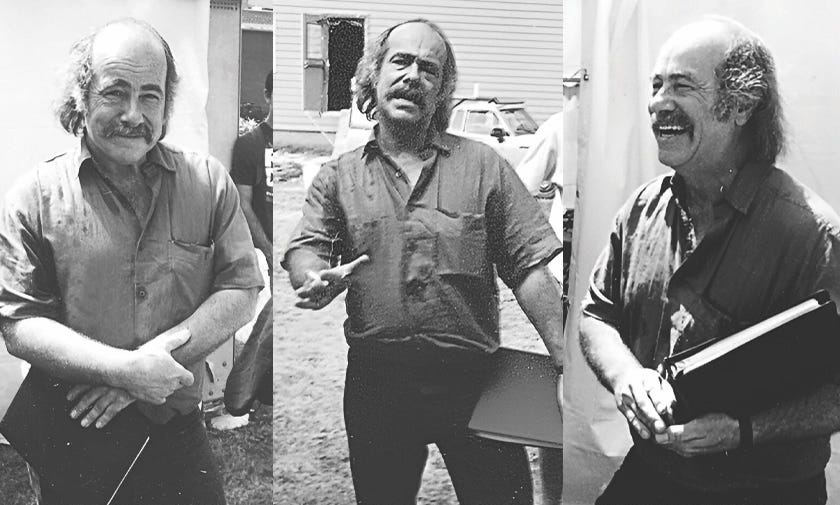
photo credit: Courtesy of Allen Ginsberg Trust, Boulder, Colorado 1993
The full interview previously appeared in the Fall 2025 print issue of EH
On February 2nd 1992, Robert Hunter’s Northwest spoken-word tour, featuring Beat-poet Michael McClure and Ray Manzarek of The Doors accompanying him on piano, was happening in Eugene. Local painter Bob DeVine and Alan Trist, the founder of Hulogos’i Press and Managing Director of the Grateful Dead’s Ice Nine Publishing, were daily customers at Coffee Corner in 5th Street Public Market where I worked as a barista. At my request, they solicited Hunter—the often-reclusive lyricist and poet—for an Emergency Horse interview and he agreed. We met under the condition we wouldn’t discuss his family or the Grateful Dead. That evening, after sneaking in a six-pack of beer and a quick toast backstage, we performed the interview. But in the end, Hunter unexpectedly chose against Emergency Horse running our discussion. Cryptically, he wrote back that after he was gone, we could do whatever we wanted with it. Thirty-two years later, the never-before-read interview is featured where it was originally intended.
*Update: A correction from the print issue, response: “And the finer Bobbie Petersen”
EH I was hoping to talk shop, mostly—poetry shop.
Hunter I love to do that.
EH What’s the hardest lesson you’ve had to learn about poetry writing?
Hunter I’m a very heavy rewriter. And I have to learn to keep earlier drafts and refer to them, to rewrite until I have achieved a perfection which hasn’t lost the whole original feeling of what sent me out on the line in the verse of the poem in the first place. Often it’s contained in the first draft—the thing that gave you the impetus to do it and try not to lose that in rewriting. But you must rewrite—not everyone feels that way.
EH Poe said, true lyrical writing has to occur in one sitting. In one session.
Hunter Hmm.
EH I don’t think he was saying no rewriting, but in one awakened state.
Hunter Maybe . . . maybe this is true for him. I can see a certain sense, but then I think that somehow, like in the way of song lyrics, speaking that way, it is so often that some of the best stuff does come out in the first sitting. I always find a bit of polishing doesn’t do any harm. In fact, a whole lot of polishing, but never lose that initial thread; never outthink yourself, never outsmart yourself. You can toy with it, you know, filigree it, but don’t lose what you had that made it worth writing. What made you save it and think that you should rewrite it in the first place, rather than just trashing it.
EH In an interview you did with Robert O’Brien in Relix magazine you’re quoted as saying: “Writers and poets, if you overdo it you make an idiot of yourself, and if you under do it you don’t say anything.” Would you like to discuss?
Hunter When the devil did I say that? I don’t remember. I do have a tendency to say anything that appears to me cool at the time, I must say. (laughter)
EH What’s interesting about the statement is: what makes oneself project their work out to the point where it loses its connection to where it’s going—the audience, the reader. Where does it become idiocy, the extreme?
Hunter I think it’s the same answer as the last question. If you work an emotion to a fine-point intellectual pitch, you’re going to sacrifice some of the emotion. You’re going to end up with something where every detail, every joint of it looks correct and for some reason it doesn’t sing, doesn’t ring—it just doesn’t do it. I can look at that stuff; pages of things I’ve done like that to, and I think I’ve written something really fine. I put it away and look at it next year. I can’t even read the stuff, my eye just slips to the bottom of the page.
EH It’s just not holding you at all.
Hunter Yes.
EH I’ve found that too. Where there’s a lot of excess which, at the time, feels really good. But then you go back and the music isn’t there—it gets lost. But the feelings are there, and somehow you’ve got to go back and mine it out.
Hunter If you can. If you haven’t exhausted that feeling to the point that you betrayed it and can’t go back and get it. You gotta just walk away from it.
EH Robert Petersen’s book, Alleys of the Heart, which you wrote the introduction for, some of my favorite poetry I’ve read from the past twenty or thirty years. I’m really curious about him and what his influence might have been or just anything that might illuminate where all this beautiful writing came from?
Hunter Back in those days, I considered Petersen a poet and I was just a lyricist. I had a great deal of awe and respect for him as a poet. I didn’t think of myself as one [poet], and it took some pretty heavy changes in my life that threw me against the wall. The only way I could respond to them was by going deeper. I guess through these rather tragic circumstances I became a poet, as opposed to just a lyricist. But it was necessity that did that. I started learning the craft that way. I consider poetry and lyricism two different crafts.
EH Certainly.
Hunter One thing, when I’m writing I have a little rhyming dictionary in my head. I must’ve prowled through every rhyme. There is so many times that I know not to end a line with: this, that, or the other word. Because there are only going to be very few other ideas or words you’re going to find, and you’re going to get hackneyed ideas. It’s sometimes best to use a false rhyme, or drop the rhyme a little bit. I can just count on my fingers, like in an abacus, when I’m running to something for scansion [the meter or metrical pattern of poetry]. I forget what the question was?
EH Petersen.
Hunter Oh Petersen, Petersen. By the way, I have a great deal of respect for his lyric work. It’s a talent like anything else.
EH I think some of the lyrics of this century are much more interesting than the poetry. At least the poetry of the latter half: Van Morrison, Bob Dylan, Hank Williams; there’s a lot of them.
Hunter Hank Williams?
EH Yeah.
Hunter I love Hank Williams. I’m not sure that I would put his writing in the same breath as Van Morrison and Dylan.
EH They came after. They had the benefit of what he did.
Hunter They did.
EH I look at his stuff [Williams]: The images are real, concrete, and they move smoothly. The phrasings are what I find interesting. I think that’s what I love about he and Woody Guthrie: Their phrasings.
Hunter Woody Guthrie was an amazing phraser. His legacy can’t help, but to live on by anybody who’s been influenced by the folk scene. I have no idea how much I’m influenced by Woody Guthrie. I would expect a great deal. Back to Petersen, ah... he was writing some great, great stuff. He had some kind of knack. It isn’t my knack, but I sure can appreciate what he’s done. I don’t know what I’ve learned from him...
EH He was an unschooled poet. It seemed from what I can gather. He really was a street poet in the true sense. And a mountain poet too.
Hunter He could talk poetics though. He just had a connection to the gut and the heart, through the head that worked real well and was who he was.
EH That’s the sense I get most of all... a man and his life.
Hunter And the finer Bobbie Petersen1, also, is what’s in the poetry. Because the man himself, you know, bit of a disgraceful drinker and roustabout. In trouble, jail—all the good dramatic stuff, you know. But it didn’t allow him to live very long. But the finer side of Bobbie Petersen is in that book, Alleys of the Heart.
EH How do you feel about your new book of poetry coming out? [Night Cadre].
Hunter I’ve only read the book two or three times since it’s come out. I remember one night I just read it through in a sitting. I put it down and said, ‘This is silly.’ (laughter) Other times when I look at individual pieces they’ll shine for me again. I’m pleased with it, I think I wouldn’t have thought several years ago, maybe, that I would have turned out something as crafted as well as I think I crafted that. But it’s only a jumping off point. Because I feel rather a beginner at the craft, really. I’ve been writing poetry, per se, seriously for about five or six years now. I’ve written my share of poetry over the years, but never thought of myself as a poet, and just expressing myself one way or another. But there’s a twist, there’s a change at some point. I feel I’m serious. I think I could be good. I intend to pursue it, because it fills a need in me that lyrics don’t fill.
Also, I’ve been writing a lot for the Dead this week. It’s been a very, very heavy week. The Dead’s in rehearsal right now, and I’ve pinned down five to six songs this week. Working through rewrites. Oh, I do find that my lyric flow is considerably easier since I practice poetry all the time. I’m always working on it. But when it’s time to write lyrics, I find that it just falls out of my head in a way, with much less torture than it used to. The machine is oiled. If I want to put it into my old forms of rhythm and rhyme, fine. But the new stuff will fit into it. I’m real pleased. The band’s pleased with what I’m coming up with.
EH When I go from poetry to lyrics, I have a hard time adjusting to the rigors that a lyric needs. You just can’t open up an image, or do some of the things that poetry is just so free to do; especially these days, with a lot of good precedent Projective verse. Do you have trouble when you go back into lyric work from the poetry?
Hunter No. That’s just the thing that I’m not having.
EH Because you got the muscles?
Hunter Yeah, right I’ve got the muscles. I’m a carpenter, I know how to make dovetails. It’s second nature now. Speaking of Projective poetry; you’re speaking of Charles Olson. I just read Tom Clark’s biography of Olson, Allegory of a Poet’s Life. I’m wading my way through Olson’s Maximus Poems, right now. Michael McClure says that I can get some tapes of him reading his work.
EH It’s very helpful.
Hunter Really curious about his cadences. It’s like John Ashbery, suddenly it became clear at long last. Although I read all of his [Ashbery] selected poems; never did it truly come clear till I finally heard him reading. I know his cadences now. All of a sudden his stuff just opens up.
EH Who are some of your other favorites? Poetry that you return to for inspiration.
Hunter That I return to? I’m a real big Wallace Stevens head. I just think he’s so magnificent that all you can do is fall down and worship (laughter). So phenomenal. The piece I’ll be reading tonight; ‘An American Adventure’—a long piece, I don’t think it owes anything particularly to Wallace Stevens, other than trying to obey the dictums of ‘Notes to A Supreme Fiction.’ It must be abstract, it must change, and it must give pleasure. I’ve tried to apply that to the piece. We shall see.
I have so many favorites, then somebody asks me and I always draw the blank. I’m extremely fond of some of the better of the San Francisco Language poets. San Francisco-Berkeley Language poets.
EH Leslie Scalapino?
Hunter I love Leslie Scalapino’s stuff. It’s so blunt and rude and lyrical; a lyrical thing that Leslie has.
EH Her long poem, That They Were at the Beach, is so interesting. The way she reads it too—her use of pauses as the piece builds into a longer rhythm.
Hunter Linda Hejinian—she’d hate me to say this I think, but I believe there’s a real romantic there who’s putting herself through the language strainer and coming out winners.
EH Real romantics always hate you to say it.
Hunter She accused me of being a romantic. But she said I was a cynical romantic, which is the only kind that she liked. (laughter)
EH How many languages have you accumulated?
Hunter French is my major language. I’ve done it for six years, that and in school. I just picked up sufficient German to do my Rilke translations and immediately forgot it. [Duino Elegies]
EH Could you explain how you went about doing the translations?
Hunter I didn’t have any intentions of doing it all. I just sat down one night and everyone was out of the house. I was looking over the Spender translation—I just thought that I would paraphrase Spender in a way that brought out what I thought was happening in it. But then I thought, wait a minute, what do I really know here. So I went out and bought myself German dictionaries and German grammars and started breaking down the words—eventually got a little bit of a knack for it. I had no intention of making a translation, I was just amusing myself one evening. I liked what I had gotten, enough to start doing it just a little bit more seriously. But I must have been half way through that translation before I had any idea that I might actually finish it and do some publishing. I was doing it strictly for the love of it.
EH Do you use a computer?
Hunter Yes.
EH Has that brought any changes?
Hunter It makes editing a dream. It makes cut and paste a dream. I mean, lyrics I used to simply cut and paste; you know, write them on notebook paper, type them and cut out the good verses and put ‘em around the floor, paste them together, retype them. I’d have a whole circle of stuff around me. I’ve always done what a computer does, which is edit.
EH Productivity increases with it I guess?
Hunter I’m afraid it does; the damn thing is broken, indeed it does.
EH Gary Snyder also uses a computer. He wrote a poem for Wendell Berry in defense of the computer. Because Berry’s article against it [computers] kept me from getting one.
Hunter It’s just a glorified typewriter. Don’t have to get paste on your fingers with it. I don’t really consider that what I’m doing is computing. I’ve just got a fine electric typewriter.
EH Do you compose on it?
Hunter What do you mean, music?
EH Compose a poem right on the computer?
Hunter Yeah. To begin with there’s a little bit of space between you and it. There’s something artificial and after a while it’s like a typewriter or anything else you use, it just becomes how you write it down.
EH Some of your writing seems to definitely come from place, specific places. Whether they’re listed or not. Usually they seem to have a sureness of place. Are there favorite places of yours in California or what not?
Hunter Oh... you’re asking a different question than I thought you were, because I was about to decline to answer that. But, oh, place. I am a Westerner. My time on the east coast was only about two years, other than that I’ve been a Westerner. What comes out of me is gonna be Western, it’s not gonna be New York; as much as I wouldn’t mind it being sometimes. You gotta be who you are. God strike that! (laughter) That’s not true—you must strive to be who you are not. (laughter)
EH So what would your job description of a poet be?
Hunter (pause) A poet is someone who writes poetry. The question is: what is poetry?
EH I’m getting at that.
Hunter That’s circular isn’t it? Job description. There are as many different job descriptions as there are differing poets. If there were one job description, there’d only be one kind of poetry.
EH I think about different things in regards to poetry. Is it its own end? Like Shelley took that stand.
Hunter That’s not human nature for it to be its own end. As human beings we’re ambitious creatures and when we write something, it might be, you forget that you got other goals and you’re totally immersed in it. Yes, it is its own end at the time. Then it wants to be something else. It wants to be a piece of a book, or it wants to be something you can read on the stage, or something like that. I don’t know.
EH What do you hope happens when you put it out on the stage, or when you publish a book?
Hunter Well, I’m going out right now for the purpose of trying poems out—a bunch of new stuff, not all new stuff. I can see by the audience reaction whether I’m hitting what I want to hit or not. Poetry is first and foremost a spoken form; I think we have to get back to that. It must be able to be spoken, it’s akin to the breath. So this is work for me tonight—poetry work. I’m writing up there in a way. Never forget, when you’re on stage your primary object must be to entertain your audience. It must entertain, it must give pleasure; right, the third principle of the ‘Supreme Fiction.’
EH There was a good quote I came across the other day about being a poet. I’ll run it by you and see what you think, or if you have something to add. To Bob Dylan, an interviewer commented: “Van Morrison said that you are our greatest living poet. Do you think of yourself in those terms?” Dylan: “Sometimes it’s within me. It’s within me to put myself up and be a poet. But it’s a dedication. It’s a big dedication. Poets don’t drive cars. Poets don’t go to the supermarket. Poets don’t empty the garbage. Poets aren’t on the PTA. Poets, you know, they don’t go picket the Better Housing Bureau, or whatever. Poets don’t! Poets don’t even speak on the telephone. Poets don’t even talk to anybody; poets do a lot of listening, and they usually know why they’re poets. Yeah, there are, what can you say, the world don’t need any more poems—it’s got Shakespeare. There’s enough of everything, you name it, there’s enough of it. There’s too much of a little electricity, maybe; some people said that. Some people said that the light bulb was going too far. Poets live on the land, they behave in a gentlemanly way and live by their own gentlemanly code.”
Hunter That’s a nice poem! That is a poem whether you agree or disagree with the ideas. You appreciate the ideas for what they open up in you. Because poets don’t talk. I’m not a poet right now. I’m a poet when I sit down in front of a piece of paper to write poetry. Other than that I go to the store, I take out the garbage, and I answer the phone—nobody else will.
*Update: A correction from the print issue; Hunter response: “And the finer Bobbie Petersen” .
Darrin Daniel is the EH poetry editor, and publisher of Cityful Press Books.
Thanks to Maureen Hunter for permission to feature this interview.
©2025 by Maureen Hunter, Darrin Daniel, and Emergency Horse.